Individual income taxes are very progressive:
- If you make $50,000/year, you pay 16% in taxes
- If you make $100,000/year, you pay 22% in taxes
- If you make $500,000/year, you pay 32% in taxes
In contrast, business taxes are completely flat. The federal corporate income tax rate is a flat 21%. Which means that:
- A small local corporation making $100,000/year in profits pays 21% in taxes
- A regional chain making $10M/year in profits pays 21% in taxes
- A nation-wide business making $1B/year in profits pays 21% in taxes
In fact, the truth is even more weird. The bigger a corporation, the more lawyers and accountants they can hire in order to perform tax wizardry, apply for tax breaks, and thus lower their effective tax rate. Net result: large corporations on average pay only 9% of their profits in taxes.
The argument for flat corporate-taxes is simple. If you impose progressive taxes for corporations, they will just split themselves into many smaller corporations, in order to reduce their tax bill. Instead of one business with $1B in revenues, you will have 10 businesses each with $100M in revenues. And merely through the act of splitting themselves up, they will accumulate significant tax savings.
My response: that is exactly the reason we should have progressive tax rates!
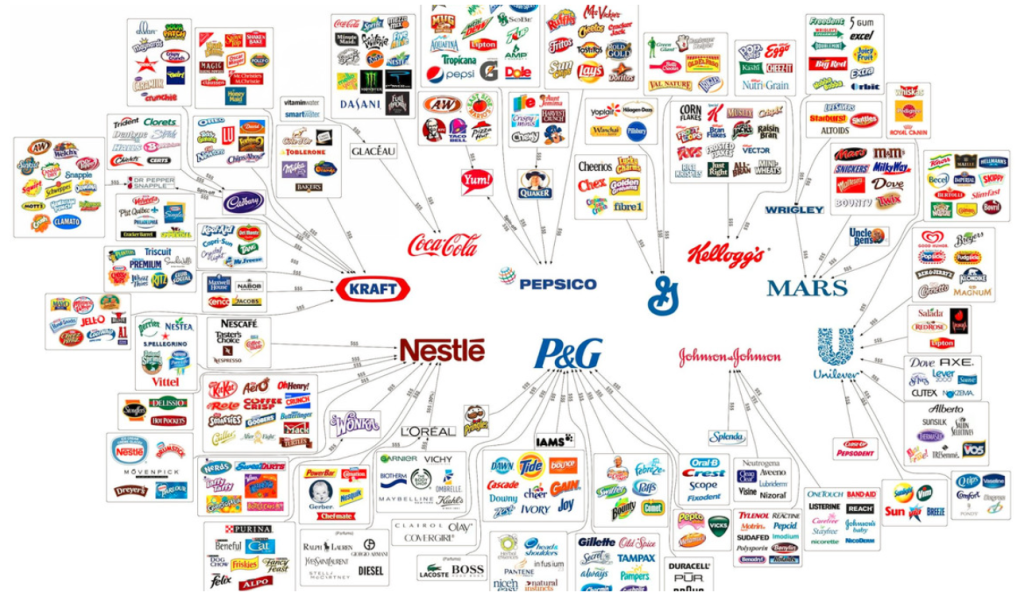
Mega-corporations are bad for our nation and bad for the world. For many reasons:
- With less competition, they face less pressure to innovate
- With less competition, they can more easily jack up their prices and short-change consumers
- Workers have fewer options on companies to work for, which leads to depressed wages, worse benefits, and worse working conditions
- Large corporations can use their sheer size to smother smaller competitors that offer somewhat better products, which leads to stagnation and harms consumers
- Large corporations have more political power and spend more on political lobbying. Which means they can better influence politicians and write new laws in their favor
- CEOs of large corporations, like Murdoch or Zuckerberg, wield a tremendous amount of power. Such concentration of power in so few hands, especially those that were never elected by society, is unhealthy for democracy
Free markets are the greatest economic system we have ever found, and free markets work best when there is lots of competition. Hence why mega-corporations are completely antithetical to a free market economy. Anything we can do to break up large corporations into smaller companies would make the world a better place.
This is exactly why antitrust legislation originated a century ago. Unfortunately, antitrust regulators have been handed an unsolvable problem. They are trying to play whack-a-mole with a far richer adversary who can always find new ingenious ways to get around specific provisions in antitrust legislation.
Consider Meta for example. At one time, Meta was simply Facebook. But today, they have also absorbed Instagram and WhatsApp (and attempted to buy Snapchat). One wonders why none of this was blocked by antitrust regulations, in order to promote greater competition in the social media marketplace.
Meta is hardly alone. When you look at companies like Google, Microsoft, and Amazon, the hundreds of companies they have bought over the years, and the countless products they are selling, it is clear that they are not the same nimble, agile, singularly focused companies that once changed the world. Rather, they have now become lumbering colossal conglomerates where our best and brightest go to become “millionaire engineers who get paid gobs of money and barely work.”
Progressive taxes let you achieve the same goal as antitrust legislation, but more effectively. We no longer need to dictate to companies who they can and cannot merge with, or when they need to spin off different business groups. Such micromanagement and bureaucratic oversight is no longer necessary. Instead, all we need to do is tell them that the more money they make, the higher the tax rate they will have to pay. As soon as you do this, companies will automatically find the best way to break themselves up into numerous smaller companies. If there is one thing history has shown, it is that capitalists are ruthlessly efficient at minimizing their tax bill.
It is worth noting that some companies do see significant and worthy benefits from operating at scale. Something economists refer to as “economies of scale.” Instead of government bureaucrats trying to determine which companies deserve economies of scale, we can let progressive taxes and the free market sort itself out. Conglomerates that see minimal benefits from scale will choose to break themselves up, in order to pay lower taxes. Whereas companies that actually do see massive benefits from scale will choose to remain intact – paying higher taxes on high profit margins is still far better than paying lower taxes on razor-thin profit margins.
As much as I would love to claim sole credit for this idea, it turns out others have already made this same argument two years earlier. To quote tax expert Prof. Avi-Yonah:
The reason to have a progressive tax on rents is that in addition to targeting rents, we also want to discourage bigness, which is equivalent to monopoly or quasi-monopoly status. The less competition a business firm faces, the more profitable it is likely to be, because competition generally drives down prices. That is why the most monopolistic firms are also the most profitable, and why they engage in behaviors like ‘killer acquisitions’ designed to eliminate competition.
At the top, the corporate tax rate should be 80% for income above $10 billion, like the excess profit taxes of the two world wars. In 2019, this rate would have applied to the Big Tech. Other corporations that had profits over $10 billion in 2019 include other major tech companies, Big Banks, Big Pharma, Big Oil, Big Telecoms, United Health, Boeing, and some major consumer brands. All of those enjoy some degree of monopolistic or quasi-monopolistic status.
Such a high tax rate may persuade the corporations subject to it to split up. Splitting up corporations to reduce their profits and therefore escape the 80% tax rate is a feature of the proposal and not a bug: as FTC commissioner Lina Khan and others have proposed, we should ideally want to induce Big Tech to divest their anticompetitive acquisitions (e.g., Facebook’s acquisitions of Instagram and WhatsApp). And if the tax structure also motivates an actual break-up of the core business (e.g., along geographic or business segment lines), any loss in efficiency would be more than compensated by the removal of the threat to democracy posed by Big Tech.
Free markets work best when there is lots and lots of competition. Competition forces companies to compete with each other on price and quality of service. Competition gives employees more power and employment options. A marketplace that isn’t dominated by monopolies and oligopolies is also one with a more level playing field. Where a handful of conglomerates and CEOs can’t use their immense power to lobby for special interests and win favors from politicians. For all these reasons, an economy with hundreds of thousands of small, agile, nimble corporations, will fare far better than an economy with 50 conglomerates that dominate every aspect of our life.
Unfortunately, trying to stop the growth of mega-corporations by fiat is a fool’s errand. Whatever dictates you throw in their way, they will find some way to bypass it. The only way to solve the problem is through a policy that is so simple that it cannot be loopholed or bypassed.
“The greater your total profits, the higher tax rates you will need to pay.” This one rule will be more effective than all the antitrust legislation in the world. Make it worth their while, and corporations will do everything they can to split themselves up into smaller companies.
 Outlook Zen
One thought on “The Best Way to Break Up Mega-Corporations: Progressive Taxes”
Comments are closed.