
The developed world is headed towards extinction.
Just take a look at this table showing fertility rates across every developed nation. Of the 53 countries, only one has a fertility rate above replenishment. The average fertility rate is about 40% lower than what is needed simply for replenishment. Here in America, the average woman only has 1.6 children in her lifetime, and birth rates are at an all-time low. In Spain, the fertility rate is a shocking 1.2. In South Korea, that number is 0.9.
It doesn’t take a genius to figure out that if half your population is female, and each of them average 1 baby in their lifetime, each generation will be 50% smaller than the previous generation. After 10 such generations, a society that started off with a million people will wind up with just a thousand people. Imagine a city like New York shrinking to the size of a small town. And in another 10 generations, that small town shrinking to the size of a single household. That’s where we’re headed.
Why is the fertility rate so low in developed nations? Couples overwhelmingly list affordability as their main reason for not having more kids. There is some truth to this. If every couple had access to an army of nannies, a 10-bedroom mansion, and unlimited parental leave, I’m sure more couples would choose to have more kids. But is this truly the main reason for our demographic crisis?
When we look at countries that have the highest fertility rates, their citizens aren’t exactly living the high life. The countries with the highest fertility rates – Chad, Niger, Congo and Somalia – are also the most impoverished. When you look at countries that aren’t headed towards extinction, they are almost universally undeveloped or still developing.
Even when you look at Western “first world” countries, our birth rates were highest in time periods where inflation-adjusted incomes were far lower. America registered its highest fertility rate in 1909 – a time when the average male worker earned $11 per week, which comes out to about $400 per week in 2025 after adjusting for cost-of-living.
Let’s also look closer to home. Fertility rates in today’s America are highest in families with annual household income under $10,000. The second-highest fertility rates are in families with annual household income between $25,000 and $35,000. The lowest fertility rates? Families with household income above $150,000.
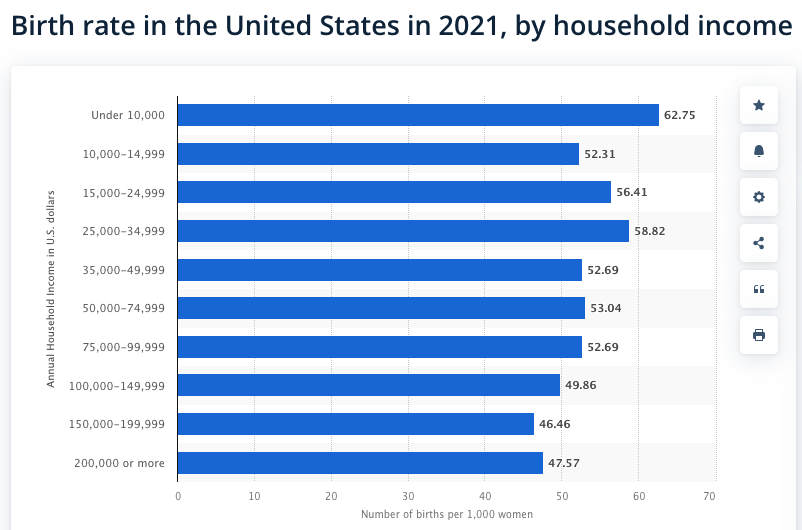
So much for finances being the main hurdle in having children. To quote research on this topic:
Cross-sectional data and long-period time series data have generally shown an inverse relationship between income and fertility
This decreasing relationship between fertility and income is well known to economists and demographers alike. In addition, it holds true over time: Rich countries, such as the U.S., have experienced a remarkable decline in their fertility rate as they became rich. Also, the relationship holds at the individual level, as rich families tend to have fewer children than poor families.
But is increasing income truly the cause of couples not having more children? It’s hard to believe that someone would have fewer kids just because you gave them a pile of money. What is far more likely is that family income is correlated to, but not the causal reason for, a drop in fertility.
For a more compelling causal explanation, just consider the following chart of fertility rate and maternal educational attainment:
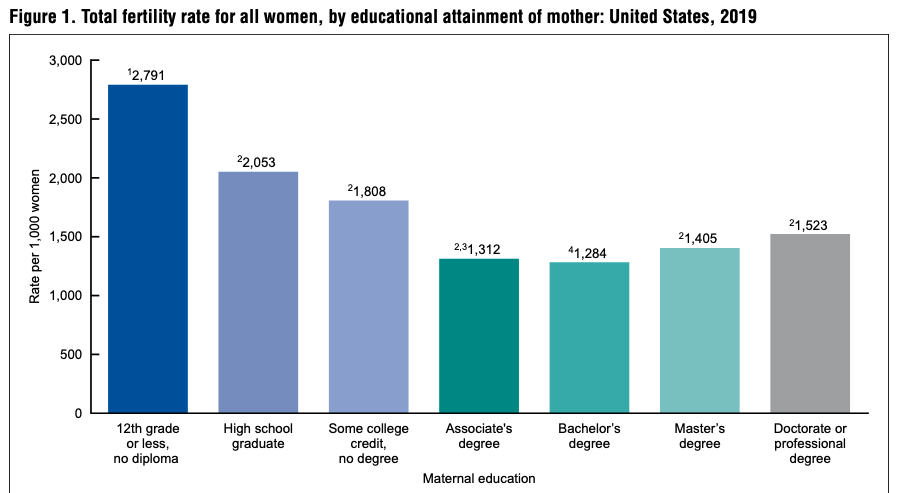
It turns out getting any post-high-school degree, and the associated focus on career, plays a huge role in how big a family someone chooses to have. Your average high-school drop-out has twice as many kids as your average college graduate.
As the parent of two young kids, this is hardly surprising. Of all the activities I’ve pursued in my life, parenting is the most tiring and draining of them all. Doubly so for women. Going through pregnancy takes an extreme toll on your body and mind. Taking multiple months of parental leave will almost certainly set you back in your career growth. Breastfeeding a baby and taking care of a small toddler will leave you with little energy for getting ahead at work. Is it any wonder that women with greater career aspirations have fewer children?
There is also a second factor at play. One of the most compelling reasons for having children is to occupy your time with a meaningful activity. To fill the void in a life that feels empty. Back in the dark ages when women were denied career opportunities, giving birth and raising small children provided an outlet for women who weren’t allowed to pursue other meaningful endeavors like education or career. Doubly so when they attended weekly services in a religion that preached the importance of family and procreation.
Fast forward to today, when women are encouraged to attend college, pursue meaningful careers, and religion takes a back seat to secular norms. When women live vibrant and fulfilling lives, filled with educational, intellectual and career aspirations and achievements, there is little void that needs filling with broods of children. Far more women are content to live a child-free life, or stop after having 1 baby and ticking off that checkbox. Almost no one feels the need to have 4 children – once commonplace in the 1950s but eyebrow-raising today – when there are so many other endeavors you can invest your time and energy into.
All of the above is wonderful at the individual level. But on a societal level, it puts us on a collision course with doom. Natural selection is an inescapable force of nature. People often misinterpret natural selection as “survival of the fittest” – where fittest refers to intelligence, strength, and health. In reality, “fittest” refers to “reproductive fitness” – the number of offspring you have given birth to, who then go on produce offspring of their own. From the psychopathic lens of natural selection, a tribe filled with illiterate women who each bear three children is more “reproductively fit” than a tribe filled with Nobel-prize-winning Olympians who opt to go child-free. The former is the one that survives the gauntlet of natural selection, not the latter.
“So what if the child-free Nobel-prize-winning Olympian does not pass on her genes? She is happy, content, and worthy of admiration. How does anything else matter?” At an individual level, I absolutely agree. I would feel immensely proud if my daughter grew up to become a child-free Nobel prize winner. The real problem arises at the societal level. A culture that liberates and empowers women, and winds up with a below-replacement fertility rate, will eventually go extinct. They will leave behind a world filled only with brutish cultures that oppress women and deny them the same liberties and opportunities afforded to men.
In fact, this may have happened already. Every single major historical civilization has been a patriarchal one where women were denied equal rights and opportunities. Is this merely a coincidence? Or did the more enlightened tribes shrink into irrelevance, and find themselves replaced by the patriarchal ones?
I don’t know about you, but I have no desire to live in a world where women are oppressed. As the proud father of a young girl, the very idea makes me sick. If someone told me that a thousand years from now, most humans would live in sexist societies, and that all the hard-fought women’s rights from the past century have been rolled back, I would feel immensely sad.
If you support the cause of feminism and equality, you have a duty to ensure that the principles of equality survive past our generation, and continue to flourish in the coming centuries.
There are a few ways to do this. One is through immigration and assimilation. Despite low fertility rates, countries like America have seen a significant population increase due to immigration. By itself, immigration does nothing to fix the problems we discussed earlier. But if developed nations made a concerted effort to assimilate its immigrants, and educate them on women’s empowerment and gender equality, this can offset a fertility rate that is below replacement levels. Despite what the racists and xenophobes may believe, there’s no reason why assimilated immigrants and their descendants can’t be champions of gender equality. After all, it wasn’t too long ago when American and European society was profoundly sexist as well.
But relying on immigration alone is not sufficient to prevent societal extinction. There are limits to how many immigrants a society can successfully assimilate each year. And to how many people will want to emigrate in the first place. For these reasons, we also need solutions to increase the birth rate to replacement levels.
Let’s start with the obvious ones. Making child-rearing more affordable, via increased tax credits or subsidized daycares. And making pregnancy itself more affordable, through government-subsidized egg freezing, IVF, and maternity expenses.
Yes, this is no silver bullet – the countries with the highest birth rates have the fewest subsidies for daycare and IVF. But these policies do help. To quote research on this topic:
An increase in the present value of child benefits equal to 10% of a household’s income can be expected to produce between 0.5% and 4.1% higher birth rates.
a paper analyzing the fertility effects of Alaska’s annual universal payment that began in 1982… the dividend increased the birth rate by 12 percent
Such tangible financially-driven programs will certainly help incrementally. But to truly dig ourselves out of our fertility hole, we need far more than just that. To quote what businesses have learnt over the past century: “Culture eats strategy for breakfast”. We need to start emphasizing civic values around having children and the importance of family. We need to abandon our unrealistic Disney-like attitudes towards dating and love, which has led to 25% of 40-year olds having never married – 4 times higher than it was in 1980. We need to encourage norms that make it easier to raise children, such as multi-generational homes where grandparents play an active role in looking after young kids.
If all that fails… desperate times call for desperate measures. Here’s two for starters. Free state-funded surrogacy for anyone who chooses it. And mandatory national service for all adults/seniors, with an exemption granted to anyone who has had at least 2 children. Yes, these are some truly wild suggestions, and I’m sure others can think of better ideas. If we’re allowed to draft young men to fight in deadly wars, in the name of national security, I don’t see why we shouldn’t consider equally drastic measures to prevent our demographic extinction.
All in all, we have taken our way of life and civilizational progress for granted. Our myopic focus on the next election cycle has blinded us to longer-term trends that are portending doom. The facts are clear. Our fertility rate has fallen well below replacement levels. We are headed towards extinction. And when we do, our ideals of women’s empowerment will die alongside us. If we truly care about defending women’s rights, it’s time we started fighting for our survival.
Related links:
https://www.nytimes.com/2025/05/12/us/politics/republicans-parents-babies-home.html
https://www.nytimes.com/2025/05/30/opinion/therapy-estrangement-childless-millennials.html
 Outlook Zen