
What is the human will?
How does the will interact with reason?
Does the will follow reason’s lead, or is the will the ultimate decider?
If the will is indeed the ultimate decider, how does it go about deciding, given that reason is responsible for all analysis?
These are questions that many famous historical philosophers have dedicated years of their lives to debating. Today, we shall discuss a mathematically rigorous model for the human will. One that offers an answer to the above, explains seemingly paradoxical behaviors, and offers some useful insights that can help us with our lives.
Delayed Gratification
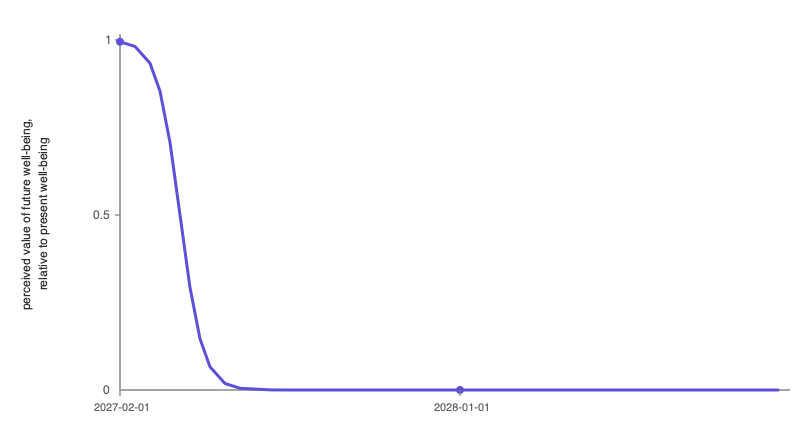
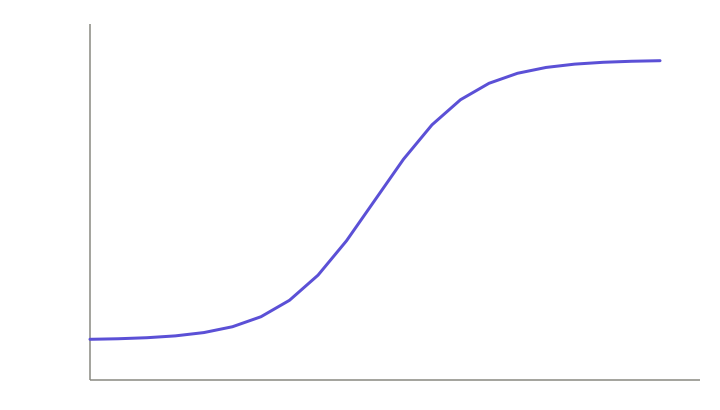
Consider the following graph:
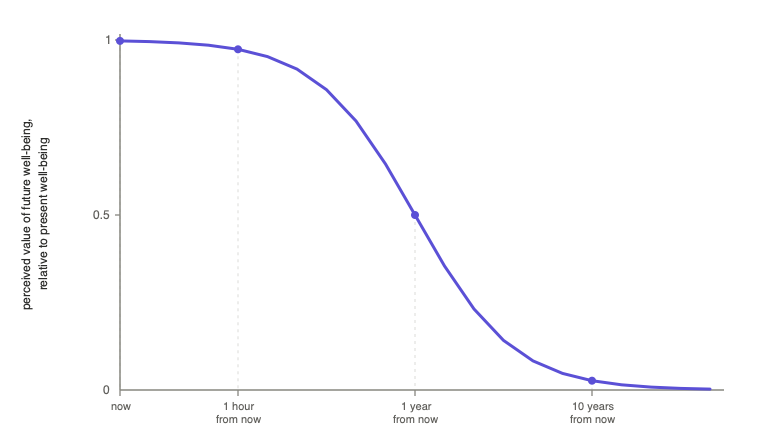
The X-axis in the above graph is time, relative to the present moment.
And the Y-axis is how much you currently value “one unit of well-being” at a future time, relative to how much you value it in the present. Or to give a grossly simplified example: if I promised you a delicious meal next year, how appealing is that compared to a delicious meal right now?
Almost everyone has a curve with the same shape as the above, illustrating the following common behaviors:
For any time range that is “close” to the present time, people’s valuation barely changes. Ie, if I promised you a delicious meal, it doesn’t matter much to you whether you eat that delicious meal 1 minute from now, or 2 minutes from now, or 5 minutes from now. All three possibilities seem almost equally desirable.
At a certain time-range however, things start to feel too abstract and unrelatable. And hence, its present value drops off rapidly. For example, if I promise you a delicious meal 10 years from now, that doesn’t seem nearly as valuable as a delicious meal today. Even if it were sealed in an ironclad contract, with all the money safely locked away in an escrow. 10 years from now simply feels too far away, too unrelatable, too abstract. This causes the curve to fall rapidly.
And finally, once you have crossed this inflection point, everything feels “equally abstract” no matter how much further you go in the future. Hence, the curve levels off again. For example, if I promised you a delicious meal 20 years from now, that seems just as valuable as a delicious meal 10 years from now. We see a massive drop-off in value when we go from today to 10 years later – but we only see a slight drop-off in value when we go even further to 20 years later.
Our ability to “reason” allows us to estimate how our actions will impact our well-being both in the present, and in the future. For example, your reasoning may tell you that you have enough money to eat one delicious meal today. But if you instead invested that money, you would have enough money for two delicious meals after 10 years. Which would give you twice as much future-well-being as one delicious meal.
The above analysis may be filled with unreliable assumptions, and may eventually prove to be false. But hey, we all need to make decisions somehow. And our reasoning abilities give us the best possible estimate of the consequences of each decision.
Does the above mean that you will forego eating that delicious meal today, and save the money instead? Two delicious meals are better than one delicious meal, so clearly you would always choose to save your money, right?
Wrong. Under the above model, we do not optimize for aggregate well-being. Rather, we all subconsciously optimize for our present perception of present/future well-being.
In essence, our decision really comes down to this: how much do we value “2 units of well-being” 10 years later, compared to “1 unit of well-being” today? Looking at the above curve, each unit of well-being in the distant future will definitely be discounted by some amount, relative to present well-being. But by how much do you discount it? If you discount it by less than 50%, you will definitely choose to save your money for 2 delicious meals next decade. Whereas if you discount it by more than 50%, you will definitely choose to buy that delicious meal today.
A Difference In Willpower
We had earlier discussed everyone’s curve following the same general “shape”. Despite this similarity however, each person’s curve has completely different parameters. Most notably, the point in time where the curve steeply falls off – everyone hits the “cliff” at a different point. Hence why everyone will assign a unique present valuation for 2 units of 2036 well-being.
Most crucially, when we talk about someone’s will, what we are really talking about are the parameters of the above curve for that individual. Two people with the exact same reasoning abilities, may still make different decisions, because their will-curve has different parameters, causing them to differently prefer immediate vs delayed gratification.
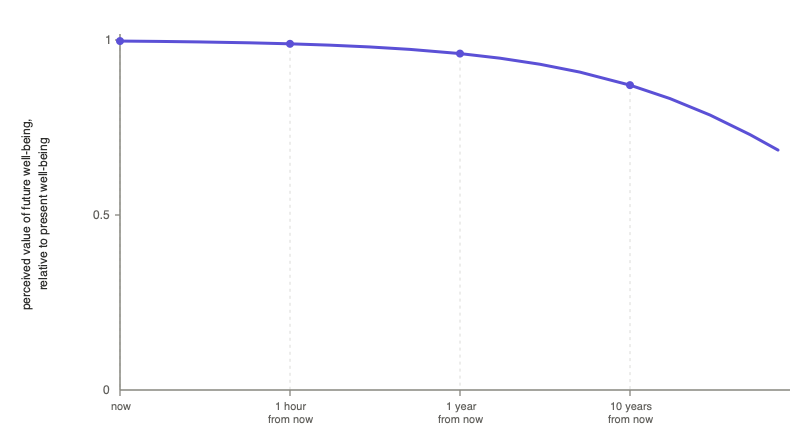
Someone with an iron will has a cliff that is infinitely far into the future. Ie, they will tolerate literally any amount of pain, and fore-go any amount of pleasure, in order to achieve a slightly greater amount of well being in the future. Their curve looks almost like a flat line for most time ranges.
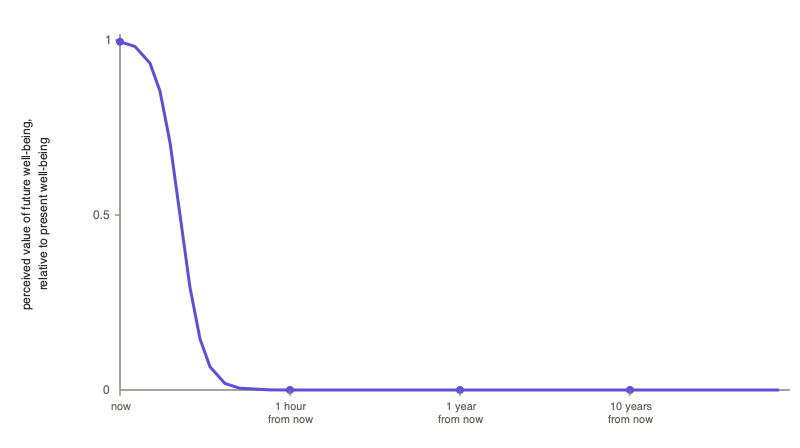
Whereas someone with an extremely weak will hits the cliff one minute from now. They will sacrifice any amount of future happiness, for a tiny morsel of present satisfaction.
This is basically the marshmallow test, except it is happening hundreds of times everyday. Do you resist the temptation to eat that sweet? Do you go to the gym twice or thrice this week? Do you push yourself just a little bit harder on that final stretch of the race? Do you study an extra ten minutes the week before your exam?
People with an iron will are making hundreds of beneficial trades everyday. They are constantly sacrificing a little bit of present happiness, for more future happiness. Over the course of their lifetime, all these tens of thousands of positive trades accumulate into a far happier life.
People with a weak will have the opposite problem. Every day, they are sacrificing more of their future happiness, for a tiny morsel of present happiness. Over the course of a lifetime, these tens of thousands of self-destructive trades pile up into a life that has far less happiness and far more suffering.
Model Predictions
The above model explains two things
First: why do some people engage in behaviors that they know are self-destructive? Why do they eat unhealthy food, avoid exercising, avoid saving for the future, even though they know it’s better for them in the long run. After all, economics teaches us that we are all rational utility-maximizing beings. So why the self-destructive streak?
The answer: under our model, people don’t optimize for future well-being. Rather, people optimize for their present perception of future well-being.
To someone with an iron will, these two are basically the same. But for someone with a weak will, their present perception of future well-being is far lower than immediate gratification. Hence why people with a strong will avoid harmful behaviors – whereas people with a weak will engage in self-destructive behaviors in exchange for a morsel of immediate gratification.
Second: why do people constantly engage in the very behaviors that they previously resolved to avoid? It is arguably understandable for someone to consistently value the present more highly than the future, and hence, never turn down a free shot of heroin. “Carpe diem, yolo!” But why would someone say “I resolve to eat healthy and exercise this year!” – and then when the time comes to actually do it, not follow through? If they truly value the present more than the future, why make that resolution in the first place?
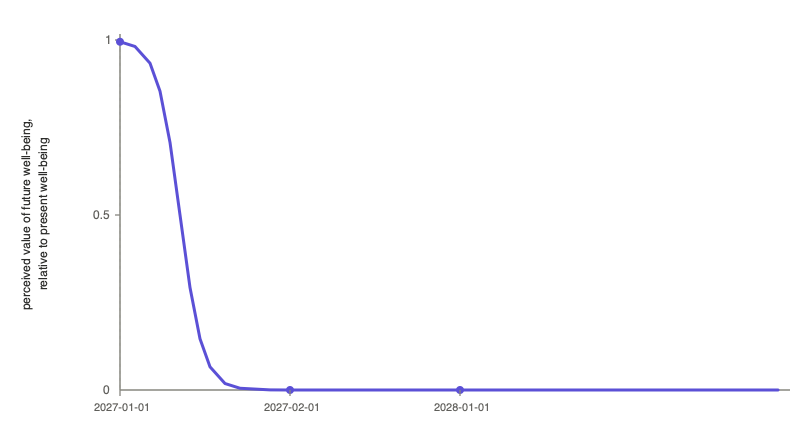
The answer goes back to the curve. Once you go beyond the cliff, all future well-being is a flat line. No matter how weak-willed someone is, they see the distant future in the exact same way as someone with an iron will! They are perfectly happy to sacrifice some well-being in the future, for more well-being in the more distant future. Hence why they make the same resolutions that someone with an iron will would. Hence why they make resolutions to go to the gym “next month”, in order to achieve greater health in the coming year.
Unfortunately for them, when the time comes to actually act upon that resolution, their perceptions of the “future” and “distant future” have dramatically changed. At the time when they resolved to go to the gym, both “next month” and “neat year” seemed equally abstract and non-valuable. Hence why they were willing to sacrifice one, for more of the other.
But when the time comes to actually follow through on that sacrifice, the very abstract “next month” has turned into the very real “today” – whereas the very abstract “next year” still remains as a very abstract “next year.” Hence why they are no longer willing to make sacrifices today, in order to reap greater benefits next year. Even though this is exactly what they had resolutely promised just one month earlier.
Model Usefulness
“All models are wrong, but some are useful.” Is this model useful to us in any way? I think it yields two practical recommendations for us.
First: understand that none of us have an iron will. Understand that we all have a cliff, and we will inevitably fail to make good decisions involving points in time beyond this cliff. Once you understand this, you will realize why you are constantly making resolutions that you will inevitably fail to follow through on. And that if you want your resolution to stick, you need to find alternative strategies.
The easiest strategy: Lock your future self into decisions that you will later struggle to undo. No matter how weak your will is, you actually have an iron will when it comes to making trades between two distant points in the future! Take advantage of this. For example, sign up for a pension plan that you can’t later back out of. Tell your partner to throw away all your goodies, and give them in writing a free-pass to do so no matter how much you later beg them not to. Your immediate-future self may hate you for this – but your distant-future self will be so glad you did.
Second: Even if you currently possess a weak will, you can functionally replicate an iron will by finding ways to change your perception of the future.
There is one core reason why we value future well-being less than present well-being – the future seems very abstract, not relatable, and not real. So change that. If you’re choosing between an iPhone today, vs a worldwide trip in the year 2045, close your eyes and imagine that it is 2045 already. Imagine what you would look like. What your life would be like. What you would think and feel while embarking upon your trip around the world. Maybe even ask AI to produce a video clip of your future self traveling to exotic locations all around the world.
In short, do everything you can to make the future feel as real and tangible as possible. (hmmmm, vision board anyone?) By doing so, you can trick your mind into thinking that the worldwide trip in 2045 isn’t happening in the “distant future”, but rather, in the “near future”. And once you trick your mind into perceiving it as a near-term tangible entity, you will value it far higher than you otherwise would.
Nuances and Critiques
One obvious critique of the above model: we can all think of people who seem to exhibit tremendous willpower in some areas, but minimal willpower in other areas.
A famous example of this is Tiger Woods. On the one hand, he has exhibited tremendous willpower by spending his entire childhood training golf diligently, out of the spotlight, with minimal immediate rewards. He could have been blowing off his childhood years like any other American teenager, but he put in a lot of hard work so that he may one day achieve great success.
But on the other hand… his willpower as an adult was so weak that he couldn’t even resist cheating on his beautiful wife with a restaurant hostess.
How can we explain such seemingly contradictory behaviors?
One potential explanation is that these differences in behaviors have nothing to do with his willpower. His willpower remains exactly the same in both cases. What truly differs are his desires. Perhaps he is so ambitious that he derives tremendous well-being from sporting success – far more than most people. Because of this, despite possessing a weak will, he still prioritized future sporting success… simply because its appeal was so immense that it dwarfed anything else he could have done in his childhood.
This explanation can also be flipped on its head to explain his infidelities. Perhaps he places minimal value on the longevity of his marriage, hence why it is so easily dwarfed by the allure of temporary flings. In both instances, his willpower remains exactly the same. The only thing that changes is the relative well-being he attains from sporting success and marital success.
An alternative explanation is that we don’t just possess a single set of parameters for our willpower curve. We all possess a different set of parameters for different circumstances. Perhaps some of us possess tremendous willpower when it comes to future career success, but far less willpower when it comes to future marital success. Hence why you often hear about extremely hard-working and disciplined people succumbing to affairs.
I personally don’t like this explanation. It seems to me a lot more believable that people like Tiger Woods simply don’t place a lot of value in marriage, rather than his character performing a complete U-turn multiple times a day. But I have to admit that I can’t definitively rule out this explanation.
Disclaimers
It is easy to use this model to judge anyone facing setbacks. “He’s unemployed because he didn’t have the willpower to work hard at his last job. She’s fat because she doesn’t have the willpower to eat healthy.” Don’t do this. Everyone can make their life better through greater willpower. But that doesn’t mean that anyone with a good life has a strong will, or that anyone with a bad life has a weak will. There are numerous other factors involved in determining someone’s life outcomes. The only thing the model predicts is relative life improvements, not absolute life quality.
Extension: Moral Will
Thus far, we have exclusively discussed willpower as it relates to personal decisions. But this concept could also be extended to moral will.
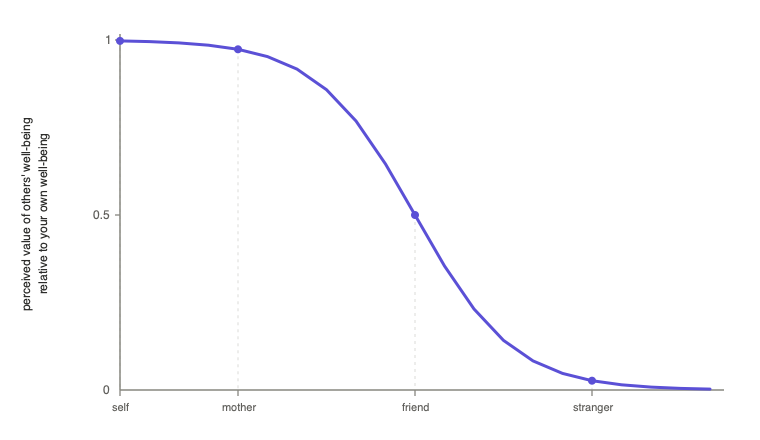
Take the exact same graph, but the x-axis now represents “psychological distance” between you and another person. This graph now answers a very different question: how much of a personal sacrifice are you willing to make, in order to help someone else?
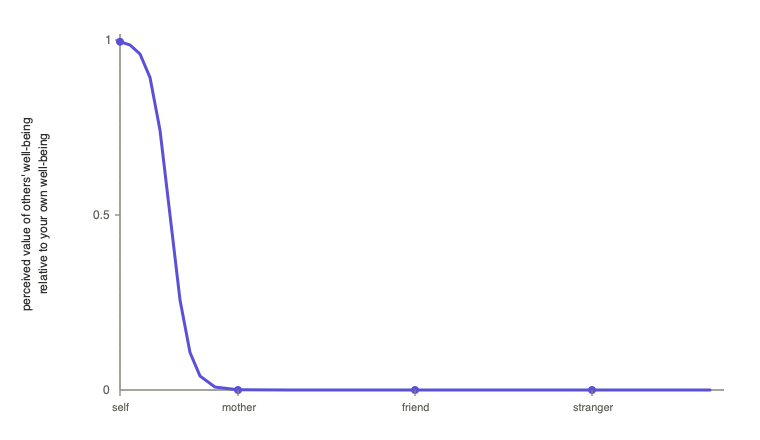
A purely selfish person has an immediate cliff: they will sell out their own mother, for a little personal benefit.
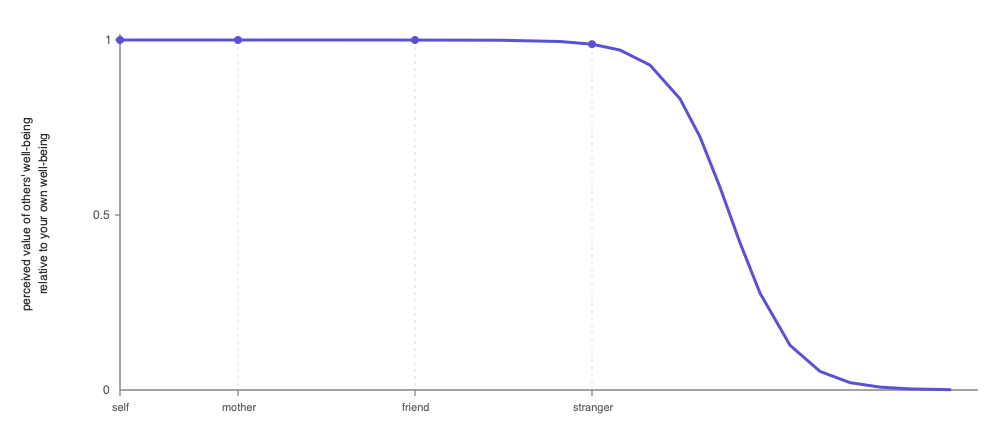
Whereas someone with an iron moral will prioritize the well-being of complete strangers, almost as highly as their own well-being. Hence why they are willing to sacrifice their lives for the good of the nation. For example, by putting their life on the line through military service, by dedicating their life to low-paying public service, or by donating large fractions of their income to help the needy.
At the societal level, the effects of such individuals are similar to the earlier effects we had discussed. Virtuous people constantly make thousands of trades everyday that leave society as a whole better off. At a micro-level, a single trade may make them worse off. But on the aggregate level, people living in a virtuous society will experience far greater well-being.
The exact opposite is true of selfish people. They make thousands of trades that damage society as a whole, for a little personal benefit. On a micro-level, a single trade may make them better off. But on aggregate, everyone suffers from a far lower quality of life when living in a society filled with liars and cheats.
We earlier discussed how our model of personal will matches two real-world observations. We can also find close parallels of both observations in our model of moral willpower.
First: why do some people engage in behaviors that are so destructive and harmful to others around them? This one may seem obvious, but it’s really just a re-skin of what we had discussed earlier. People don’t optimize for aggregate well-being – people optimize for their own perceived value of others’ well-being.
To someone with tremendous moral will, these are effectively the same thing. They will never subject a stranger to significant harm, for a milder personal benefit. Whereas for someone with weak moral will, they perceive such little value in others’ well-being, that they will not hesitate to harm them simply for their own mild benefit.
Second: why do people engage in the same behaviors that they advise others to avoid? For example, politicians criticizing others for taking bribes, only to later be caught taking bribes themselves. This too, is simply a re-skin of what we had discussed earlier. No matter how selfish someone is, once they get past their “cliff”, they value the well-being of all other strangers equally. Hence why they encourage distant acquaintances to treat strangers with kindness and respect.
Unfortunately, even though they place equal value on the well-being of distant acquaintances and complete strangers, they place far greater value on their own well-being. Hence why people are far more likely to tell others to be selfless, than to practice selflessness themselves.
The above model for moral will also yields the same insights that we had earlier gleaned from our original model.
First: understand that none of us have an iron moral will. Understand that we all have a cliff, and we will inevitably fail to make good decisions involving anyone on the other side of this cliff. Once you understand this, you will realize why you are constantly preaching morals to others that you yourself do not live up to. And that if you want to truly practice what you preach, you need to find alternative strategies.
For example, excusing yourself from workplace decisions where you have a conflict of interest. Or following the moral advice of a trusted third party, rather than simply following your own biased instincts.
Second: Even if you currently possess a weak moral will, you can functionally replicate an iron will by finding ways to change your perception of others’ well-being. There is one core reason why we massively discount the well-being of strangers – they seem very abstract, not relatable, and not real.
So change that. If you’re choosing between an iPhone for yourself, vs a worldwide trip for a stranger, close your eyes and imagine yourself as that stranger. Visualize what your life would be like. Imagine how you would feel to receive such a gift. What you would experience while embarking upon your trip around the world. Maybe even ask AI to produce a first-person video clip of that stranger traveling to exotic locations all around the world.
In short, do everything you can to make that stranger feel as real and tangible as possible. Ie, put yourself in their shoes. By doing so, you can trick/persuade your mind into valuing a stranger’s well-being almost as highly as your own well-being, and functionally act in the same way as someone with immense moral willpower.
The above models for personal will and moral will are extremely similar. Is there a high correlation between the two? Are people with strong personal will also more likely to have a strong moral will? I suspect there is a partial correlation between the two, but that is purely speculation on my part.
An Inverted Curve
Thus far, we have discussed everyone having different parameters in their willpower curve, but still following the same general shape. Ie, the curve starts off high, and then drops off in a reverse-S shape.
But is it possible that some people have a curve with a completely different shape? For example, someone whose curve looks like this:
Someone with a curve like the above would value present well-being less than future well-being. Or they value their own well-being less than a stranger’s well-being. The former may be a hoarder or a miser. The latter may be a people pleaser.
Both groups of people may think they are being ultra-virtuous by sacrificing present well-being for future well-being. Or by sacrificing their own well-being for the good of others. But in reality, their trades are all net negative. They sacrifice significant present well-being, for a smaller amount of future well-being. Or they sacrifice significant personal well-being, for a smaller benefit to others around them. They may think they are paragons of virtue – but because they are making net-negative trades, they are constantly making their own life, or society as a whole, worse off.
Fortunately, the vast majority of us do not face the above problem. The vast majority of us place greater weight on present well-being, and our own well-being. I doubt you will go wrong by trying to be more forward-thinking and more altruistic in your life.
Related links:
Construal level theory – examining “psychological distance” as a function of time, location, and social connections
Intertemporal decision-making theory
How individual differences in future self-continuity impact saving rates
How episodic future thinking helps achieve weight loss
Using computers to enhance future self-continuity
How humanity’s moral circle has expanded over time

