In the past, we had discussed the reasons why democracy is fundamentally flawed, needs to be overhauled, and what its replacement should look like.
Admittedly, it was a highly abstract topic. Hence why we had also discussed a simple idea of how democracy could be reformed, to look more like the Jury system, as opposed to mob rule.
Today, I’d like to propose another way of reforming Democracy. One that is more complex, but very intuitively simple. One that closely models the way we ourselves make decisions, seek advice, and live our lives, every single day.
Imagine a village of 20 people, voting on whether to adopt Amendment #17412. If you’re wondering what Amendment #17412 is all about… welcome to Democracy. Too often, we find ourselves having to vote on the basis of issues that we barely know about, and are certainly not experts in. And this village is no different. Some people are highly knowledgeable about the issue, but others aren’t. Regardless, like good citizens, they all go to the ballot box anyway & vote according to their best knowledge.
And here’s what the results look like:
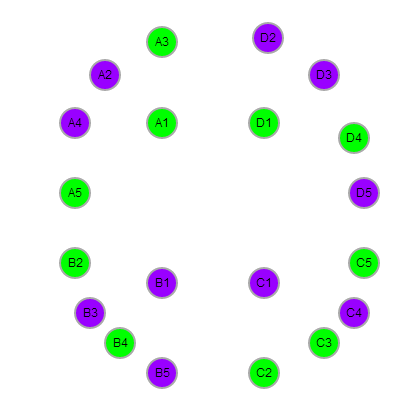
A seemingly random splattering of yes votes (green) and no votes (purple) all over. We’ve just witnessed democracy in action.
Now suppose we tried something slightly different. Instead of just asking people to vote on Amendment #17412, we also ask them to name someone they know personally, whom they most trust on this issue.
And here’s what that might look like:
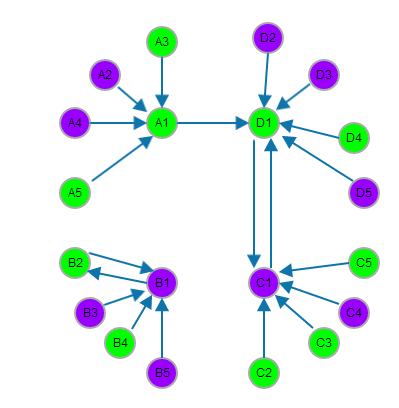
A few patterns immediately start emerging. You can see that a few people, A1, B1, C1 & D1, are highly respected by the community. Presumably because they are knowledgeable, wise, and trusted by the people around them.
At this point, a few quick words about Google, and how they were able to make use of the above patterns to unlock new information & achieve unparalleled success. Back in the 1990s, there were numerous companies trying to succeed in the Search Engine marketplace. Lycos, AskJeeves, AltaVista… the list goes on. And yet, sometime in the early 2000s, they all just disappeared and everyone switched to Google. Their search engine, simple enough that it could be built by a couple of students in a garage, was so great that it simply blew the competition away. When you look into how they implemented this groundbreaking search engine, one of the main pillars was the PageRank algorithm.
I could write an entire article about PageRank but to put it simply, it brought democracy to the internet. It gave every single website the ability to vote on any other website, through the act of linking to it. And Google for its part, crawls through the web everyday, tallies up all the ballots, and posts the winners near the top of their search results. It is in many ways very similar to democracy… with one very important twist. Every website gets a different number of votes based on how trusted it is, as measured by the number of other websites that link to it.
To give an example, suppose the Nobel Prize winner Eugene Fama decides tomorrow to start an economics blog. It’s so insightful & interesting, that NYTimes decides to link to it. Suppose that at the same time, Joe Blow, who took a community college class on Economics, also starts an economics blog… and his brother-in-law who works at the Street Sheet links to it as well. We now have 2 blogs, on the same topic, carrying the same keywords, and each having a link from a newspaper. A purely egalitarian search-engine would give them equal visibility. But Google’s knows that NYTimes is a lot more trusted than Street Sheet, since it has accumulated millions of people linking to it. Hence, it gives NYTimes thousands of ballots more than Street Sheet, and this in turn gives Eugene Fama’s blog a huge well-deserved boost over Joe Blow’s.
It’s a very simple concept, and yet, looking at the quality of search results returned by Google as opposed to its now-extinct competitors, it makes all the difference in the world.
Now suppose we applied this same algorithm to our village’s electoral process. Here’s what the results would look like:
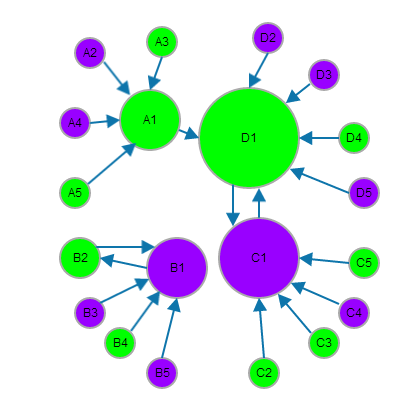
You can see that the patterns we noticed earlier, have produced real electoral results. Because individuals A1, B1, C1 & D1 are so highly trusted by their communities, they are given more votes than everyone else. Going one step further, since person D1 is highly trusted by both A1 and C1 who are themselves highly trusted, this gives D1 the most voting power of all. What earlier seemed like a random splattering of votes, now has a real structure to it. The signal to noise ratio of the voting process has been tremendously improved.
The exact algorithm used might be mathematically complex, but the underlying principle is dramatically simple and intuitive. When you find yourself having to make a tough decision, what do you do? Do you go on facebook, create a poll, and ask all your 700 friends to vote on it? Or do you approach a few people whom you and others trust the most? If they themselves are not sure about the answer, you might go one step further, and ask them to refer you to others who are even more knowledgeable on the topic. Ultimately, you would consider the advice given by these few highly trusted individuals to be just as valuable as the semi-informed opinions of your other 700 friends put together.
And this is exactly the same principle on which Google’s PageRank algorithm is based, and has worked so successfully. We all intuitively understand this same insight and apply it in our lives everyday. It’s time we started applying it in our political process as well. Doing so can change our electoral map from a noisy random splattering of votes, into a highly sophisticated & structured network of trusted information. We may not all get an equal number of votes, but that’s fine. After all, we’re not all equal experts in governance or public policy. However, we all would get an equal say in deciding who the trusted members of our community should be. It could be your brother, your father, your daughter, your teacher, or your priest. And ultimately, trusting in the wisdom of the wisest individuals in our community, will take us a lot further than polling our entire facebook feed.
Related Links:
Discussion thread on /r/philosophy
More details about the Google PageRank algorithm
Why democracy & equal voting is fundamentally flawed
Another suggestion to reform democracy, using the Jury system as a model
 Outlook Zen
Basically you’re proposing to allow proxy voting on electoral issues. Couldn’t you do the same thing now with absentee ballots by just letting someone else fill them in for you? (Whether that’s legal or not I don’t know, but it seems like it would work in concept.) Or asking your trusted friends which way you should vote? Don’t get me wrong, I’m not knocking the idea of knowledgeable people being given more influence in the processes of government. That’s what a meritocracy is supposed to be. This system that you’re proposing though does seem like it would require an incredible amount of trust–people would have to name someone to essentially vote in their place. And if they’re willing to go that far, it seems like they’d be willing to do the easier task of voting themselves the way their trusted friend says that they should.
You’re right that it does seem somewhat similar to a proxy-voting system, with one big difference. With this system, no one has to give up their vote, in order to designate someone else whom they trust. Using the example given, even though person D1 is the most trusted person in the network, even he can still designate C1 as someone whom he trusts, while still maintaining his voting power. The PageRank algorithm also has non-linear elements to it, as opposed to absentee voting. When person A1 designates his trust in D1, that has a greater impact than person A2 designating his trust in A1. This is in fact a key feature of PageRank which makes it a successful algorithm. Such non-linear relationships wouldn’t be possible through a absentee-ballot system.
You’re right that if everyone got together, discussed the trust network in great detail, and found out exactly what their trusted friends are voting on for every single choice in the ballot, they could recreate this system. However, the coordination costs of doing all this is humongous. In practice, the people least knowledgeable about politics, are also the ones least likely to discuss it in-depth with their friends. This system represents a simple way for them to harness the wisdom in their social networks, without them having to manually do so themselves,
Apart from referenda, isn’t this just normal democracy?
Various parties propose people to represent you, and you vote for the one you trust the most to think about these things and make an informed decision.
Or in a referendum, people actually just ask those people they respect what they think.
In an ideal democracy Kevin, this is exactly what would happen. People would vote for representatives whom they know personally & trust, and those representatives would then make all the hard decisions.
In practice, unfortunately, the ties between the representatives & an average constituent are so weak, that voting on the basis of whom you know personally & trust is not feasible. In practice, people form their own beliefs about small government vs big government, stimulus spending vs tax cuts, immigration reform vs build a fence… and they then vote for representatives & parties who promise to carry out these measures. Representatives who make unpopular votes on controversial topics like immigration reform or healthcare overhaul, get swiftly punished by voters who feel otherwise. Eric Cantor is a great example. One day, he’s the 3rd most powerful & trusted GOP representative in the country. The next day, he comes out in favor of some immigration reform, and is swiftly booted out in the primaries by his own party.
There’s actually an entire post that discusses this issue in more detail if you’re interested:
https://outlookzen.wordpress.com/2013/11/29/direct-vs-representative-democracy/
May I comment that in a true democracy there are no representatives. I mean this in its purest form. Of course all democracies have representatives, however the republic form of government, as well as a democratic republic, off representative based alternatives.
Just wanted to clarify that portion of the voting process. Democracy isnt flawed, its just not made for 1 billion people. Its made for 1000 athenians, if you get my drift.
The main difference between this and the democracy we live in is more choice. I don’t like either choice our last presidential elections, but there are many people who are not running who I would put my faith in. This system allows anyone to be voted for and does not require those voted for to do anything.